Before You Start: What Every NZ Player Should Know

Before depositing real money on Chicken Road, there are several things every New Zealand player should understand and prepare for. Taking these steps seriously will make your experience safer and more enjoyable.
Try the demo first. If you have not already, spend time with the free demo version. It uses the same RNG and mechanics as the real-money game, so you will get an accurate feel for the gameplay, the crash patterns, and the difficulty levels without risking anything.
Set a budget before you deposit. Decide how much money you are comfortable losing entirely -- because losing is a real possibility with any gambling game. This amount should be money you do not need for rent, bills, food, or other essentials. Once your budget is set, commit to it absolutely.
Understand the house edge. Chicken Road is a fair game with a built-in mathematical advantage for the operator. Over many rounds, the expected outcome for the player is a net loss. Individual sessions can go either way, but treating Chicken Road as an income source is a fundamental mistake. It is entertainment with financial risk.
Know the support resources. Before you play, save the Gambling Helpline number: 0800 654 655 (free, confidential). If gambling ever stops being enjoyable or starts causing stress, reach out. There is no shame in asking for help.
Choosing a Platform: What NZ Players Should Look For

Since Chicken Road is hosted on offshore platforms not regulated by the DIA, choosing where to play is arguably your most important decision. Here is a systematic approach:
Verify licensing. The platform should display its gambling licence clearly. Look up the licence with the issuing authority to confirm it is current and genuine. A platform that hides or misrepresents its licensing is not worth your time.
Check for Provably Fair support. The genuine Chicken Road game supports Provably Fair verification. If a platform offers the game but does not support hash verification, you may be playing a counterfeit copy.
Test customer support. Send a question before depositing. How quickly and helpfully do they respond? Good pre-signup support is a strong indicator of a well-run operation. Poor or absent support before you are a customer will only get worse afterwards.
Research withdrawal reputation. Search for independent player reports about the platform's withdrawal speed and reliability. This is where untrustworthy operators tend to reveal themselves. Consistent complaints about delayed or refused payouts are a deal-breaker.
Confirm NZD support. Platforms that accept NZD deposits and process NZD withdrawals save you currency conversion fees. Over time, those fees add up meaningfully.
Verify responsible gambling tools. Deposit limits, loss limits, session timers, cooling-off periods, and self-exclusion should all be available. A platform without these features is not taking player welfare seriously.
Registration and Account Verification

Once you have selected a platform, the registration process typically involves:
1. Creating an account: Provide your name, email address, date of birth, and residential address. Use accurate information -- false details will cause problems during withdrawal verification.
2. Email verification: Confirm your email address via a link sent to your inbox.
3. Identity verification (KYC): Most reputable platforms require identity verification before you can withdraw. This usually involves uploading a photo of your NZ driver licence or passport, plus a proof of address document such as a utility bill. This is a standard anti-money-laundering requirement and a sign of a legitimate operator.
4. Setting responsible gambling limits: Before your first deposit, configure deposit limits, loss limits, and session time reminders. Do this immediately -- it is much easier to set limits when you are calm and rational than when you are in the middle of a session.
A tip for NZ players: complete the KYC process before depositing if the platform allows it. This avoids delays when you want to withdraw. Finding out your documents are needed at the point of withdrawal is frustrating and can create unnecessary waiting periods.
Depositing NZD: Payment Methods for New Zealand Players
New Zealand players typically have access to several deposit methods. The best choice depends on your priorities around speed, fees, and convenience.
NZ Payment Methods Overview
| Method |
Speed |
Fees |
Notes |
| POLi |
Instant |
Usually free |
Popular NZ option, connects to internet banking |
| Bank Transfer |
1-3 business days |
Varies |
Widely accepted, slower processing |
| Visa/Mastercard |
Instant |
May apply |
Some NZ banks may block gambling transactions |
| E-Wallets |
Instant |
Varies |
Availability depends on platform |
POLi is a particularly popular option for Kiwi players because it connects directly to your internet banking, processes instantly, and is widely supported by NZ banks. It avoids the card-blocking issues some players experience with Visa or Mastercard.
Whatever method you choose, deposit only the amount you have budgeted. Do not increase your deposit to qualify for a larger bonus unless that increased amount is genuinely within your comfortable entertainment budget.
Your First Real-Money Session: Practical Tips

Your first real-money session is where the demo experience meets reality. Here is how to approach it sensibly:
Start on Easy or Medium difficulty. Even if you spent time on Hard or Expert in the demo, begin your real-money play at lower volatility. The psychological pressure of real money changes your decision-making, and lower volatility gives you more rounds to adjust.
Use small bet sizes. Keep individual bets to a small percentage of your deposit -- ideally no more than 2-5%. This gives you enough rounds to actually enjoy the session rather than burning through your bankroll in a few bets.
Use auto-cashout initially. Setting auto-cashout at a modest multiplier (1.50x-2.00x) removes the emotional pressure of split-second decisions. As you become more comfortable, you can experiment with manual cash-out.
Set a session time limit. Decide in advance how long you will play and stick to it. The fast pace of Chicken Road (30-35 rounds per minute) can make time disappear. A 20-30 minute session is a reasonable starting point.
Never chase losses. If you lose your session budget, stop. Increasing bet sizes to try to recover losses is the single most destructive habit in gambling. Walk away and come back another day with a fresh budget and a clear head.
Responsible Gambling Tools: Use Them Before You Need Them

Responsible gambling tools exist for a reason, and the time to set them up is before you start playing, not after a problem develops. Here are the key tools available on most reputable platforms:
Deposit Limits: Set a daily, weekly, or monthly cap on how much you can deposit. Once the limit is reached, the platform blocks further deposits until the period resets. This is your most important safety net.
Loss Limits: Set a maximum amount you are willing to lose in a defined period. The platform will restrict play once the limit is hit.
Session Time Reminders: Receive alerts when you have been playing for a set duration. The fast pace of crash games makes it easy to lose track of time.
Cooling-Off Periods: Temporarily block yourself from the platform for a set number of days. Useful if you feel your gambling is becoming excessive.
Self-Exclusion: Permanently or long-term block yourself from the platform. This is a serious step for serious situations, and it should be available on any responsible operator.
In New Zealand, external support is also available. The Gambling Helpline (0800 654 655) is free, confidential, and available to anyone. The Problem Gambling Foundation offers face-to-face counselling and online resources. If gambling is causing you stress, financial difficulty, or relationship problems, reach out. These services are designed to help.
Withdrawing Your Winnings: What NZ Players Can Expect
When you are ready to withdraw, the process generally involves:
1. Verify your identity: If you have not completed KYC already, you will need to do so before your first withdrawal. This is standard practice and protects both you and the operator.
2. Select a withdrawal method: Many platforms require you to withdraw via the same method you used to deposit. Check the available options and any associated fees.
3. Processing time: Withdrawal speed varies by platform and method. E-wallets tend to be fastest, while bank transfers may take several business days. Reputable platforms state their processing times clearly.
4. Check for bonus wagering locks: If you accepted a bonus, ensure you have completed the wagering requirements before requesting a withdrawal. Withdrawing before clearing wagering may forfeit the bonus and associated winnings.
If a platform consistently delays or refuses legitimate withdrawals, it is a serious red flag. This is one of the most important factors when choosing where to play -- check independent reviews of withdrawal experiences before depositing.
Understanding the Crash Multiplier System
Before committing real NZD, understanding how the multiplier works is essential. The crash multiplier is the core mechanic that determines every outcome and sets Chicken Road apart from traditional pokies.
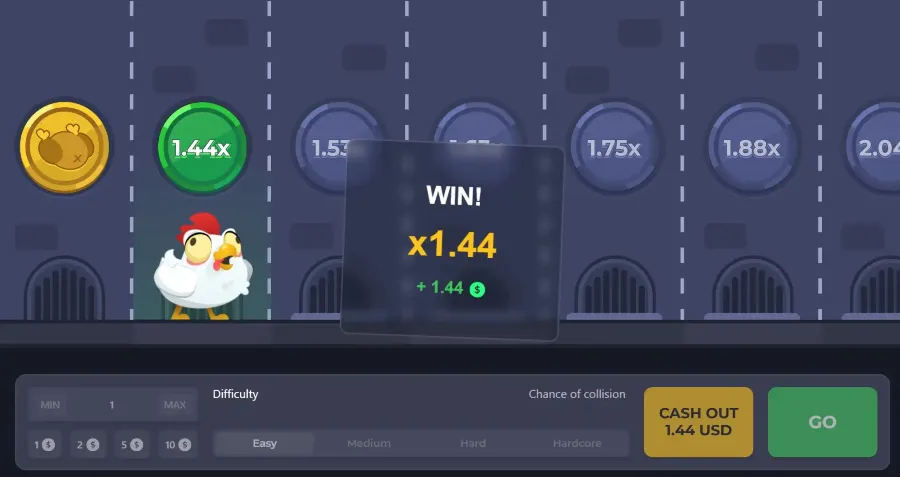
How it works: Each round starts at x1.00. The multiplier climbs continuously through x1.10, x1.25, x1.50, x2.00, x3.00 and beyond. At a randomly determined point, the round crashes. If you cash out before the crash, your bet is multiplied by the current value. If not, your stake is lost entirely.
The probability curve: Lower crash points occur more frequently. Roughly half of all rounds crash below x2.00. About a quarter crash between x2.00 and x5.00. Multipliers above x10.00 are genuinely rare. This distribution creates the house edge and means conservative cash-out targets succeed more often than aggressive ones.
Four difficulty levels: Chicken Road offers Easy, Medium, Hard, and Expert modes. Each adjusts the volatility of the multiplier distribution. Easy mode provides the gentlest experience with more predictable outcomes. Expert mode opens up the potential for massive multipliers but comes with far more frequent early crashes.
Difficulty Level Comparison for NZ Players
| Level |
Volatility |
Best For |
Recommended Budget |
| Easy |
Low |
First-time crash game players |
From NZ$10 |
| Medium |
Moderate |
Players with some crash game experience |
From NZ$20 |
| Hard |
High |
Experienced players comfortable with swings |
From NZ$50 |
| Expert |
Maximum |
Players who accept significant variance |
From NZ$100 |
Auto cash-out: Rather than making a split-second manual decision, you can pre-set a target multiplier. If the round reaches your target, the system cashes out automatically. This removes the emotional pressure and helps maintain discipline -- a valuable tool for NZ players building their crash game experience.
Bankroll Management for Kiwi Players
Smart bankroll management does not change the house edge, but it dramatically improves your experience and reduces the risk of harmful overspending. These approaches are practical and proven.
The percentage rule: Keep each bet to 2-5% of your session bankroll. A NZ$20 deposit means bets of NZ$0.50 to NZ$1.00 per round, giving you at least 20 rounds of play. This ensures a meaningful session length where you can actually enjoy the game rather than exhausting your budget in a handful of bets.
Session budgeting: Divide your weekly gambling budget into separate session amounts. If you spend NZ$40 per week on entertainment gambling, split it into two NZ$20 sessions or four NZ$10 sessions. Once a session budget is used, stop. Do not borrow from future sessions.
The stop-loss approach: If you lose 50% of your session bankroll, end the session. Starting with NZ$20 and reaching NZ$10 is your signal to walk away. This prevents the destructive cycle of chasing losses with increasingly desperate bets.
Win targets: If your session bankroll grows by 50%, consider cashing out and ending on a positive note. The discipline to stop while ahead is one of the most valuable habits any gambling player can develop. There is no guarantee the good run will continue.
These strategies are about sustainable entertainment, not about beating the game. The house edge is a mathematical constant. But a player with good bankroll habits will have a far better long-term experience than one who bets impulsively.