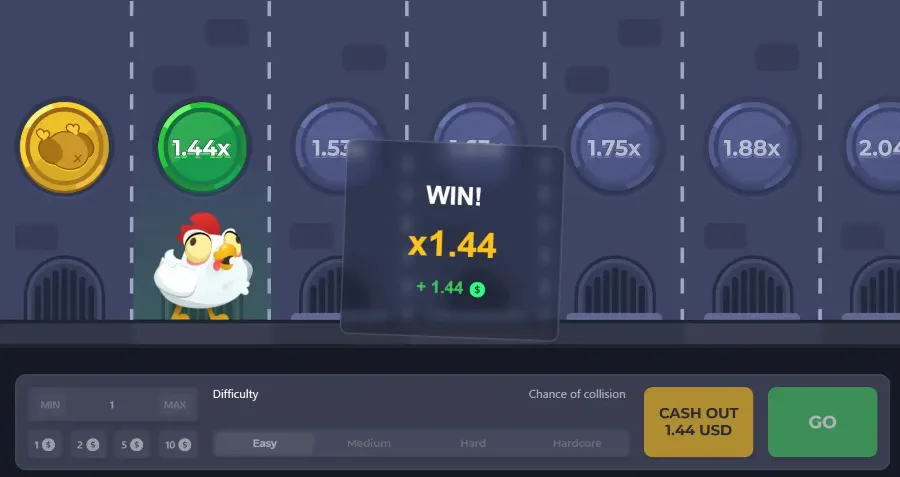
What Is the Chicken Road Demo? Free Crash Game Without the Risk

If you have never played a crash game before, the demo is where you should start -- full stop. Chicken Road's free demo mode runs the same InOut Games engine, the same RNG, and the same crash probability curves as the real-money version, but your bankroll is virtual credits that cost nothing and replenish automatically.
For Kiwi players coming from pokies at the local RSA or online slots, crash games feel like a different planet. There is no spin button, no payline grid, no scatter-triggered bonus. Instead, you are watching a multiplier climb in real time and deciding when to bail. The demo gives you space to internalise that rhythm -- the tension of watching 1.5x tick to 2.0x, the gut punch when you hold too long and the round crashes at 1.8x -- without losing a cent.
The demo runs in-browser on any device. No app download, no account creation, no email signup. It is particularly useful in New Zealand's regulatory context: since offshore platforms are not DIA-supervised, being able to evaluate the game's fairness independently before depositing is a genuine advantage. Play a hundred rounds, check a few Provably Fair hashes, and form your own opinion before committing real NZD.
All four difficulty levels (Easy through Expert) and the auto-cashout feature are available in demo mode. Experienced players use the demo to backtest strategy changes -- for example, comparing 50 rounds at 1.50x auto-cashout versus 50 rounds at 2.20x to see which approach suits their risk tolerance. The data you collect in demo mode applies directly to real-money play because the underlying maths is identical.
Fairness and Transparency: What the Demo Proves

One of the most valuable aspects of the Chicken Road demo is that it lets you evaluate the game's fairness before risking any money. You can observe the crash distribution over dozens or hundreds of rounds, track how often different multiplier ranges appear, and develop your own sense of the game's volatility at each difficulty level.
The game uses Provably Fair technology, which means every round -- including demo rounds -- generates a cryptographic hash before the round starts. After the round concludes, you can verify the hash against the actual crash point to confirm the result was predetermined and not altered. This is a level of transparency that traditional pokies simply cannot provide.
For Kiwi players who are cautious about online gambling -- and you should be cautious -- the demo offers a way to build genuine confidence in the game mechanics before any money changes hands. Spend time in demo mode, verify a few round hashes, observe the crash patterns, and decide for yourself whether you trust the system before making a deposit.
The Department of Internal Affairs does not regulate offshore crash games directly, which means the burden of due diligence falls on you as a player. Using the demo to evaluate the game independently is one of the smartest things you can do before committing real funds.
How the Free Demo Version Works

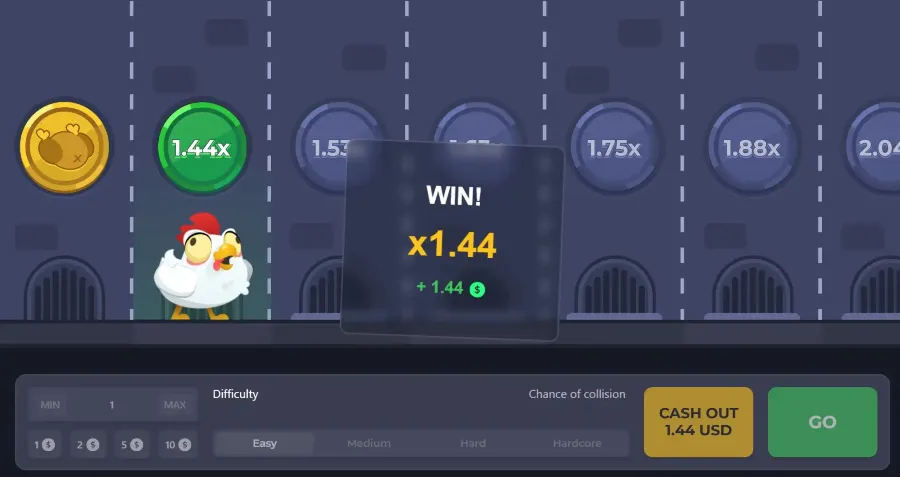
The demo version follows the exact same gameplay loop as the real-money game. You place a virtual bet, the round begins, the chicken starts crossing, and the multiplier ticks upward from 1.00x. You hit the cash-out button whenever you choose, or the round crashes and your virtual stake is lost.
All four difficulty levels are available in demo mode: Easy, Medium, Hard, and Expert. You can switch between them freely to experience how each level affects the crash frequency and multiplier distribution. Easy mode is the gentlest introduction; Expert mode shows you the full volatility of the game.
The auto-cashout feature also works in demo mode, which is particularly useful for testing strategies systematically. Set a target multiplier, run a series of rounds, and track your results. This gives you a realistic sense of what a particular approach might yield over time -- without spending a single dollar.
Virtual credits refresh automatically, so you never run out. There is no session limit, no time restriction, and no pressure to switch to real money. The demo exists purely as a tool for exploration and learning. Use it for as long as you want before making any financial decisions.
Demo vs Real Money: The Key Differences
| Feature |
Demo Mode |
Real Money Mode |
| Currency |
Virtual credits |
NZD (at supported operators) |
| Registration |
Not required |
Required (with ID verification) |
| Game mechanics |
Identical |
Identical |
| RNG algorithm |
Same certified RNG |
Same certified RNG |
| Provably Fair |
Available |
Available |
| Financial risk |
None |
Real money at stake |
| Withdrawals |
Not applicable |
Yes, subject to operator terms |
| Bonuses |
Not applicable |
Welcome offers may apply |
| Emotional intensity |
Lower |
Significantly higher |
The most important difference is not technical -- it is psychological. Playing with real money changes how you make decisions. The pressure of actual financial risk makes it harder to stick to rational strategies. Rounds that would not bother you in demo mode can trigger emotional responses when real NZD is on the line. Be aware of this shift and prepare for it before switching.
Testing Strategies in Demo Mode: A Practical Approach

The demo is the ideal place to test different approaches before committing real money. Here are some practical strategies worth exploring in demo mode:
Conservative Auto-Cashout
Set auto-cashout at a low multiplier (1.50x to 2.00x) and run 50 or more rounds. Track your win rate and overall return. This approach yields frequent small wins but you will never catch a big multiplier. It suits players who prefer steady, lower-risk gameplay.
Medium-Risk Manual Play
Play manually at Medium difficulty, aiming to cash out between 2.00x and 4.00x based on your judgement each round. Track how often you time it correctly versus how often you get caught by the crash. This builds instinct for the game's rhythm.
High-Volatility Exploration
Switch to Hard or Expert mode with small virtual bets and let rounds run longer. This shows you the full range of possible outcomes, including the rare high multipliers. It is educational but not a sustainable strategy for real-money play.
The critical lesson from demo testing: no strategy beats the house edge over time. What you are really testing is which approach gives you the most enjoyment within a sustainable budget. The demo helps you find your comfort zone before real money enters the picture.
What to Observe During Demo Play
Playing the demo casually is fine, but using it as a structured learning tool gives you a genuine edge when you switch to real money. Here is what experienced NZ players recommend tracking:
| What to Track |
Why It Matters |
How to Track |
| Win rate by difficulty |
Calibrates expectations for real play |
Count wins vs losses over 30+ rounds |
| Average multiplier at cash-out |
Identifies your natural risk tolerance |
Note the multiplier each time you cash out |
| Longest losing streak |
Reveals the worst-case scenario for budgeting |
Count consecutive losses in each difficulty |
| Emotional triggers |
Identifies when you make impulsive decisions |
Note when you change difficulty or bet size impulsively |
Difficulty-level observation plan: Spend at least 20 rounds on each difficulty level. Start with Easy, then Medium, Hard, and Expert. For each level, note your win frequency, average cash-out point, and how the experience feels emotionally. Most NZ players discover that their comfortable real-money difficulty is one level below what they enjoy in demo mode.
After your demo session, ask yourself: "If every round had cost me $2 NZD, would I still feel good about how I played?" If the answer is no, you need more demo practice before risking real money.
Simulating Real-Money Sessions with Demo Credits
The most effective way to use the demo is to pretend you have a fixed NZD budget and play accordingly. This bridges the gap between "free play" mindset and "real stakes" discipline.
| Simulation Scenario |
Virtual Budget |
Max Bet per Round |
Target Rounds |
| Conservative session |
$20 NZD |
$1 (5%) |
30�50 |
| Standard session |
$40 NZD |
$2 (5%) |
40�60 |
| Extended session |
$80 NZD |
$4 (5%) |
50�80 |
Run at least two full simulation sessions before depositing. Track your ending balance in each simulation. If you consistently deplete the virtual budget before reaching your target number of rounds, your betting or cash-out strategy needs adjustment.
What the demo cannot simulate: The emotional intensity of real-money play is genuinely different. Losing $5 NZD of virtual credits feels nothing like losing $5 NZD from your bank account. Be prepared for this psychological shift and start with the minimum bet when you first transition. You can always increase your stakes later once you have confirmed that your discipline holds up under real conditions.
When to Transition from Demo to Real Money
There is no minimum demo time requirement, but rushing the transition is the single most common mistake NZ players report. Use this checklist to assess your readiness:
You have completed at least 50 demo rounds across multiple difficulty levels and have a clear picture of your preferred play style.
You can describe how the multiplier and difficulty system works without looking at a guide. If the mechanics are still unclear, you need more practice.
You have a fixed NZD budget that you can afford to lose entirely. This is non-negotiable. If the budget would cause financial stress at zero, it is too large.
You have checked the platform's deposit methods and withdrawal process before depositing. Know how to cash out before you put money in.
You have set up responsible gambling tools if the platform offers them: deposit limits, session time alerts, loss limits. Activate these before your first bet.
If you feel pressure to move to real money quickly -- whether from boredom with demo mode, marketing urgency, or a fear of missing out on a bonus -- that is exactly when you should slow down. The game is not going anywhere, and the platforms will still be there next week.