Why Play the Chicken Road Demo First?

Jumping straight into a real-money crash game without understanding how it behaves is one of the most common mistakes new players make. The Chicken Road demo exists precisely to prevent that. It replicates the full game experience -- every difficulty level, the same multiplier mechanics, the same interface -- using virtual credits instead of real funds.
This is not a stripped-down preview or a marketing gimmick. The demo mode runs on the same underlying algorithm as the real-money version, which means the volatility you experience in demo play is representative of what you will encounter when stakes are genuine. You can test the behaviour of Easy, Medium, Hard, and Expert modes, observe how frequently high multipliers appear at each tier, and get a practical sense of the game's pace.
For UK players in particular, spending time with the demo aligns with the responsible gambling principles promoted by the UKGC, GamCare, and BeGambleAware. Understanding a game's mechanics before committing money is a fundamental part of informed play. The demo lets you develop that understanding in a completely risk-free environment, with no pressure to deposit and no personal details required to access it.
The demo is also useful for experienced players who want to experiment with strategies. If you are considering switching from a conservative low-multiplier cash-out approach to a more aggressive style, the demo lets you test that shift without any financial consequence. You can run dozens of rounds, track your results, and make an informed decision about whether the new approach suits your risk tolerance.
How the Free Demo Mode Works

Accessing the Chicken Road demo is straightforward. You do not need to create an account, provide personal information, or make any deposit. Simply load the game in demo mode and you will be credited with a balance of virtual coins. These coins function identically to real money within the game -- you place bets, watch the multiplier rise, and cash out or lose exactly as you would in a real session.
The key difference is obvious but worth stating clearly: winnings in demo mode have no cash value. You cannot withdraw virtual credits. Equally, losses cost you nothing. This zero-risk setup is the entire point: it gives you space to learn without any financial exposure.
What You Can Test in Demo Mode
| Feature |
Available in Demo |
Notes |
| All difficulty levels |
Yes |
Easy, Medium, Hard, Expert |
| Real-time multiplier |
Yes |
Same algorithm as real play |
| Manual cash-out |
Yes |
Full control over timing |
| Auto cash-out |
Yes |
Set target multiplier in advance |
| Mobile compatibility |
Yes |
Responsive across all devices |
| Provably Fair verification |
Varies by platform |
Some demos include verification, others do not |
| Bonus features |
No |
Bonuses apply to real-money play only |
If your virtual balance runs out, most implementations allow you to reset the demo credits and start again. There is no limit on how many times you can replay, making it an ideal environment for extended testing. Take as long as you need before considering real-money play.
Demo Mode vs Real Money: Key Differences

While the demo faithfully replicates the core mechanics, it is important to understand the differences between demo play and real-money sessions. The most significant distinction is psychological rather than technical.
Emotional stakes change behaviour. When virtual credits are on the line, players tend to take risks they would never accept with real money. You might happily wait for a 10x multiplier in demo mode, but with genuine funds at stake, the anxiety of a potential crash often kicks in much earlier. This is a well-documented psychological effect, and it means that demo results are not a reliable predictor of your real-money performance.
Bankroll management only matters with real money. In the demo, you can afford to be reckless because there are no consequences. In real play, your bankroll is finite and every wager represents real cost. The discipline of setting deposit limits, loss limits, and session timers -- all mandatory offerings on UKGC-licensed platforms -- becomes essential once real money is involved.
Bonuses and promotions apply only to real-money accounts. Welcome offers, cashback schemes, and loyalty rewards are not available in demo mode. If you plan to use a bonus when transitioning to real play, make sure you read the terms and conditions carefully. Our bonus guide explains what to look for.
The demo should be treated as what it is: a learning tool and risk-free practice environment. It is not evidence that you will be profitable with real money. Every crash game carries a built-in house edge, and no amount of demo success changes that fundamental reality. When you do transition to real-money play, do so through a UKGC-licensed operator and with responsible gambling tools firmly in place.
Getting the Most Out of Your Demo Sessions
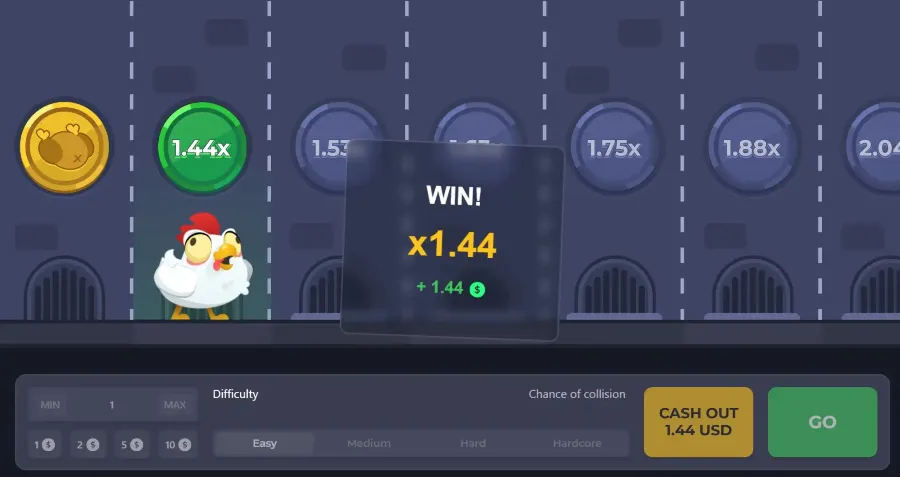
Approaching the demo with structure rather than just clicking randomly will give you far more useful insights. Here are practical recommendations for making your demo time count.
Test each difficulty level separately. Spend a minimum of twenty to thirty rounds on each tier before moving to the next. This gives you a meaningful sample of how each mode behaves -- how often early crashes occur, how frequently mid-range multipliers appear, and what the high-end potential looks like in practice.
Experiment with the auto cash-out feature. Set different target multipliers (1.50x, 2.00x, 3.00x) and observe the hit rate over several dozen rounds. This will help you understand the trade-off between frequency and size of returns, which is the central strategic consideration in any crash game.
Simulate a real bankroll. Rather than betting the maximum virtual amount on every round, pretend you have a realistic budget -- say, the equivalent of what you would actually deposit. This forces you to make decisions under constraints similar to real play, giving you a more honest assessment of how you handle the game.
Note the pace. Crash game rounds are fast. Chicken Road can run dozens of rounds per minute at higher speed settings. Pay attention to how quickly your virtual balance fluctuates. This speed is one of the reasons responsible gambling tools like session time reminders are so important in real-money play.
Do not rush to transition. There is no deadline for moving to real money. The demo is always available. If you find yourself eager to switch "because you are winning" in demo mode, pause and remember that virtual success has no bearing on real outcomes. Move to real play only when you understand the mechanics, have set your limits, and are playing on a UKGC-licensed platform.
Safety Considerations When Accessing Demo Games

Not all demo versions of Chicken Road are created equal. Legitimate demos are hosted by the game developer or by licensed operators. Be cautious of third-party websites claiming to offer "free Chicken Road" outside of these channels, as some may be fraudulent or designed to capture personal data.
Stick to known, reputable sources. If a website asks for your credit card details to access a "free" demo, that is a red flag. Genuine demo modes do not require payment information. Similarly, be wary of downloads claiming to be standalone versions of the game. Chicken Road runs in-browser and does not require any software installation.
If you do decide to move from demo to real-money play, ensure you do so on a UKGC-licensed platform. The transition should involve creating a verified account, completing age and identity checks (a legal requirement), and setting your responsible gambling limits before your first deposit. Our getting started guide walks through this process step by step.
Remember: the demo is a tool for learning, not a promise of future results. Use it wisely, set realistic expectations, and always prioritise responsible play.
What the Demo Teaches You About Multiplier Behaviour

One of the most valuable lessons the demo provides is an intuitive understanding of how multipliers behave across different difficulty levels. Spending time observing the patterns -- not to predict outcomes, but to understand the range of possibilities -- helps you set realistic expectations before real-money play.
Easy mode multiplier behaviour: In Easy mode, crashes tend to occur at moderate multiplier values. Early crashes (below x1.50) are less frequent than in harder modes, which means conservative cash-out targets are hit more consistently. This makes Easy mode ideal for understanding the basic rhythm of the game without the frustration of frequent instant crashes.
Medium mode balances risk and reward: Medium difficulty introduces more variance. You will see a wider spread of crash points -- some rounds ending early below x1.50, others reaching x5.00 or beyond. This level gives you meaningful experience with the emotional dynamics of crash games: the temptation to wait for higher multipliers versus the prudence of cashing out early.
Hard and Expert modes show the full spectrum: These levels produce the widest range of outcomes, including both frustratingly early crashes and exhilarating high multipliers. Playing these in demo mode is particularly valuable because it shows you the emotional rollercoaster without financial consequences. Many players discover in demo mode that high-volatility play is more stressful than expected.
Multiplier Observation Guide for Demo Sessions
| Difficulty Level |
What to Observe |
Rounds to Test |
Key Learning |
| Easy |
Frequency of crashes below x2.00 |
30+ rounds |
Baseline crash distribution |
| Medium |
Variance in crash points |
40+ rounds |
Risk-reward balance |
| Hard |
Frequency of early crashes vs high multipliers |
50+ rounds |
High-volatility dynamics |
| Expert |
Extreme outcomes at both ends |
50+ rounds |
Maximum variance behaviour |
The critical takeaway from demo observation is this: the multiplier distribution is fixed by the game's mathematical model. No amount of playing will change the probabilities. What changes is your understanding of and comfort with those probabilities, which directly affects your decision-making quality when real money is on the line.
Simulating Real Bankroll Management in Demo Mode
One of the most productive ways to use the demo is to simulate realistic bankroll conditions. Rather than betting wildly with unlimited virtual credits, impose the same constraints you would face with real money. This approach gives you a far more honest preview of the real-money experience.
Step 1: Set a virtual bankroll. Decide on an amount that represents what you would realistically deposit -- say, the equivalent of ?20. Mentally commit to this as your session budget in virtual credits.
Step 2: Choose a consistent bet size. If your virtual bankroll is ?20, keep bets between ?0.50 and ?1.00 per round. This mirrors the proportionate betting you should use in real play and gives you 20-40 rounds of gameplay per session.
Step 3: Set a session time limit. Even in demo mode, practice playing within a time boundary. Set a phone timer for 15-20 minutes and stop when it rings, regardless of your virtual balance.
Step 4: Track your results. Note your starting balance, ending balance, and how many rounds you played. Over several sessions, you will develop a realistic sense of the game's variance and how it affects a finite bankroll.
This exercise removes the false sense of security that unlimited virtual credits create. When you treat the demo with the same discipline you would apply to real money, the transition to real play becomes less jarring and your responsible gambling habits are already established.
Demo Bankroll Simulation Scenarios
| Virtual Bankroll |
Bet Size |
Rounds Available |
Auto Cash-Out Target |
Session Length |
| ?10 |
?0.50 |
~20 |
x1.50 |
10 minutes |
| ?20 |
?1.00 |
~20 |
x2.00 |
15 minutes |
| ?50 |
?2.00 |
~25 |
x2.50 |
20 minutes |
| ?100 |
?3.00 |
~33 |
x2.00�x3.00 |
25 minutes |
When Is the Right Time to Move From Demo to Real Money?
There is no universal answer, but here are clear indicators that you are ready to consider the transition:
You understand the mechanics completely. You know how the multiplier works, what auto cash-out does, and how each difficulty level changes the experience. Nothing about the game's basic operation surprises you.
You have set firm financial limits. You have decided exactly how much you are willing to deposit and lose without affecting your finances or wellbeing. This number is non-negotiable and comes from your disposable entertainment budget.
You have chosen a UKGC-licensed operator. You have selected a platform, verified its licence on the UKGC register, configured your responsible gambling tools, and read the operator's bonus terms (if you plan to accept one).
You are not doing it because of demo success. If your primary motivation for switching to real money is that you were "winning" in demo mode, pause and reconsider. Virtual success has zero predictive value for real outcomes. The only valid motivation is a desire to experience the game with real stakes as a form of entertainment, within a budget you can afford.
You feel no pressure. If you feel any urgency, compulsion, or external pressure to start playing for real money, that is a signal to wait. The demo will always be there. Moving to real money should be an unhurried, deliberate decision.
Structured Demo Practice: A Four-Phase Approach
The demo is most valuable when you treat it as a structured testing environment rather than aimless free play. Here is a practical four-phase approach to maximise what you learn before considering real-money play.
Phase 1: Learn the Basics (First 50 Rounds)
Play on Easy mode with auto cash-out at x1.50. Focus entirely on understanding the flow: how fast rounds start and end, where the cash-out button is, and how the multiplier behaves. Do not try to be clever � just observe and get comfortable with the interface.
Phase 2: Test Difficulty Levels (Next 50 Rounds)
Play 10�15 rounds on each difficulty level. Notice how crash frequency changes between Easy and Expert. This gives you a tangible feel for the risk-reward shift that no written description can fully convey. Most players settle on Easy or Medium for regular play after this exercise.
Phase 3: Test Auto Cash-Out Levels (50 Rounds Per Level)
Pick your preferred difficulty and run 50 rounds at auto cash-out x1.50, then 50 at x2.00, then 50 at x3.00. Track your hit rate and net result for each level. This data tells you which target produces the session experience you prefer � frequent small wins or fewer larger wins.
Phase 4: Practise Manual Cash-Out (50+ Rounds)
Switch off auto cash-out and make every decision manually. This is where you learn your emotional response to the climbing multiplier. Pay attention to moments where you cash out too early from fear or too late from greed. These patterns will follow you into real-money play, so identifying them now is invaluable.
Demo Practice Plan Summary
| Phase |
Focus |
Rounds |
Goal |
| 1. Basics |
Easy + auto x1.50 |
50 |
Comfort with the interface |
| 2. Difficulty |
All four levels |
50 |
Find your preferred level |
| 3. Targets |
Multiple auto cash-out levels |
150 |
Data on hit rates |
| 4. Manual |
Manual cash-out decisions |
50+ |
Understand your psychology |
Complete Demo vs Real Money Comparison: Every Detail Side by Side
The earlier section covers the key differences. This more granular breakdown is for players who want to be absolutely certain they understand what the demo can and cannot replicate.
| Feature |
Demo Mode |
Real Money Mode |
Difference Impact |
| RNG Algorithm |
Identical certified RNG |
Identical certified RNG |
None � outcomes are mathematically equivalent |
| Provably Fair |
Active and verifiable |
Active and verifiable |
None � both modes use the same hash system |
| Difficulty Levels |
All four available |
All four available |
None |
| Auto Cash-Out |
Fully functional |
Fully functional |
None |
| Bet Range |
Virtual credits, unlimited refills |
Real GBP, limited by your balance |
High � no financial consequence in demo |
| Emotional Pressure |
Minimal to none |
Significant � real money at stake |
Very high � decisions change under pressure |
| Session Statistics |
Available |
Available |
None � both track your performance |
| Withdrawals |
Not possible |
Available per operator terms |
Fundamental � demo winnings have no value |
| Bonuses |
Not applicable |
Available on some platforms |
Moderate � bonuses add value but come with terms |
| Account Required |
No |
Yes � UKGC verification required |
Low � one-time setup for real money |
The Psychological Gap: Why Demo Success Does Not Guarantee Real-Money Success
This is the single most important thing to understand about the demo. The mechanics are identical, but your decision-making will change when real money is involved. Research in behavioural economics consistently shows that the fear of real losses causes people to deviate from their intended strategy � cashing out too early, holding too long, or increasing bet sizes to chase losses.
The demo cannot simulate this. It is a fundamental limitation of free play in any gambling product. The best approach is to start with very small real-money bets when you transition, so the emotional adjustment happens gradually rather than all at once.
Transitioning from Demo to Real Money: A Practical Guide
When you have put in solid demo time and feel ready for real money, the mechanical transition is seamless. But the psychological shift is significant. Here is how to handle it well.
Start with the absolute minimum bet. Your first real-money session should use the smallest stake available. This bridges the gap between virtual and real stakes without putting meaningful money at risk. Think of it as a final calibration step.
Use the same strategy you tested in the demo. Do not suddenly get adventurous because real money is involved. The auto cash-out level and difficulty that worked best in your demo testing should be your starting point for real-money play.
Expect the emotional difference. Winning ?3 on a 2x cash-out feels different from winning virtual credits. Losing ?5 to a crash feels different too. This emotional weight will influence your decisions, which is exactly why your demo practice matters � you have built habits that can override the impulse to deviate from your plan.
Set your responsible gambling limits before your first session. Deposit limit, loss limit, and session timer should all be configured on your UKGC-licensed operator before you play a single real-money round. These boundaries protect the discipline you built during demo practice.
Choose a UKGC-licensed operator. Verify the licence on the UKGC public register before depositing. Complete the identity verification process � it is a legal requirement, not optional. Our getting started guide walks through this process step by step.
Remember: the demo is always there if you want to test a new strategy, try a different difficulty, or recalibrate after a rough session. It is not just a beginner's tool � it is a permanent testing ground for informed play.
Where to Access the Chicken Road Demo in the UK
The Chicken Road demo is available through online casino platforms that carry the InOut Games portfolio. Most operators that offer the real-money version also provide the free demo, usually accessible from the game lobby without requiring a registered account.
When choosing where to try the demo, the same principles apply as choosing where to play for real money. Stick with UKGC-licensed platforms. Even though you are not depositing money for the demo, you want to be sure you are playing the genuine version of the game with unaltered odds.
A quick way to verify: the demo should offer Provably Fair hash verification on each round. If the platform's demo does not support this, it may not be running the authentic InOut Games software. Legitimate operators will also clearly label the demo mode and provide a visible option to switch to real-money play.
The demo works on any modern browser � Chrome, Safari, Firefox, Edge � on desktop and mobile devices. No downloads, no plugins, no app store visits. Simply navigate to the game, select demo mode, and start playing.
One thing worth noting: demo sessions are typically not saved between visits. If you close your browser and come back later, your virtual balance may reset and your session statistics may be cleared. If you want to track your demo performance over multiple sessions, keep your own notes on hit rates and average cash-out multipliers.
Common Mistakes Players Make With the Demo
The demo is a powerful learning tool, but only if you use it properly. Here are the most common mistakes that undermine its value.
Mistakes and How to Avoid Them
| Mistake |
Why It Happens |
How to Avoid It |
| Betting maximum virtual credits every round |
No financial consequence encourages recklessness |
Simulate a realistic bankroll; bet 2�5% of a fixed virtual budget |
| Skipping difficulty levels |
Impatience to reach Expert mode |
Spend at least 20�30 rounds on each level before moving up |
| Not testing auto cash-out |
Preferring the excitement of manual play |
Run dedicated auto cash-out sessions to understand hit rates at different targets |
| Treating demo wins as predictive |
Overconfidence from a lucky streak |
Remember: virtual success has zero predictive value for real outcomes |
| Rushing to real money |
Eagerness to play for real stakes |
Complete all four phases of the practice plan before considering real-money play |
| Ignoring the pace |
Demo rounds feel inconsequential |
Note how quickly rounds pass; this speed carries over to real money |
The underlying theme is straightforward: treat the demo with the same discipline you would apply to real money. The habits you build in free play will directly transfer to your real-money sessions. If you are reckless in the demo, you are training yourself to be reckless when it counts.
When to Stop Using the Demo and Make a Decision
There is a point where continued demo play becomes procrastination rather than preparation. Here are signs you are ready to make a decision:
- You understand all four difficulty levels and have a preferred setting.
- You can explain how Provably Fair verification works and have checked at least a few hashes.
- You have a consistent strategy with a defined auto cash-out target.
- You have decided on a budget you are comfortable losing entirely.
- You have identified a UKGC-licensed operator and verified its credentials.
At that point, you either transition to real money with a clear plan, or you decide crash games are not for you. Both outcomes are perfectly fine. The demo has done its job either way.
If you decide to play for real money but later find that gambling is causing stress or financial strain, help is always available. Contact GamCare (gamcare.org.uk), BeGambleAware (begambleaware.org), or call the National Gambling Helpline at 0808 8020 133 (free, confidential).